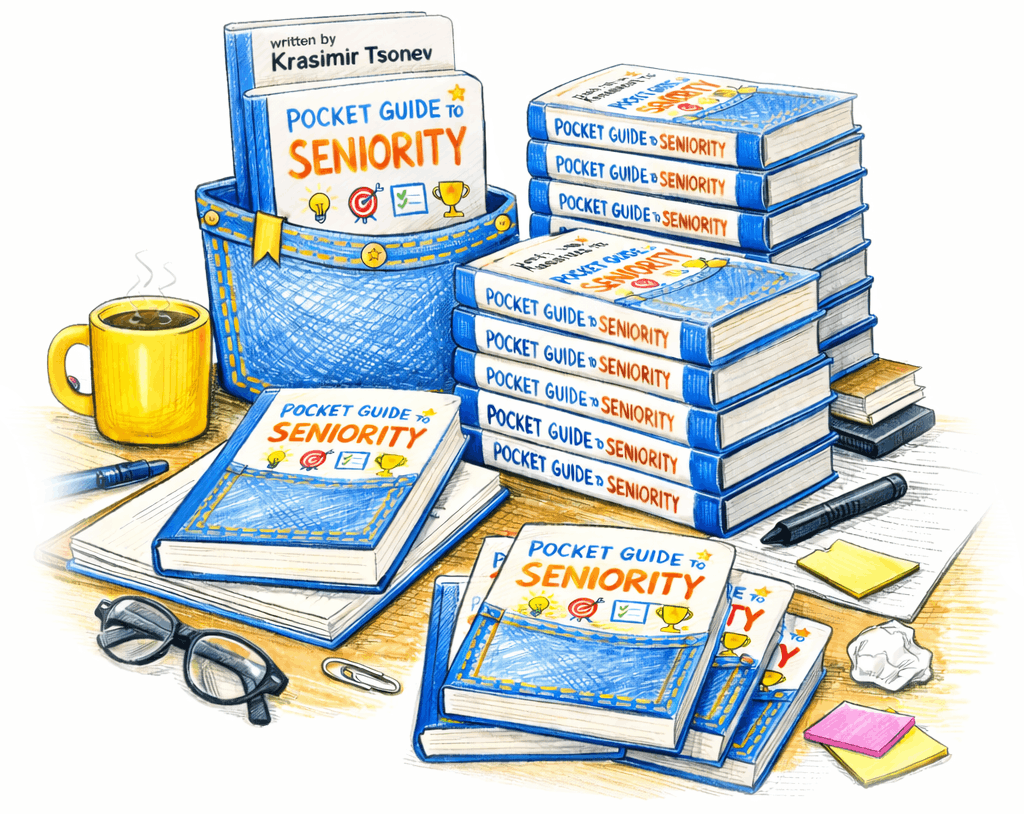
Pocket Guide to Seniority
Seniority is not about time. It is about mindset and ownership. "Pocket Guide to Seniority" is a practical guide for engineers who want to think bigger, act smarter, and grow faster.
No fluff. Just real lessons.


About the Author
Krasimir Tsonev is a software engineer with over 20 years of experience in the industry. He has worked at various companies, from startups to large enterprises, and has a passion for helping others grow in their careers. Krasimir is also the author of several technical articles and open-source projects.
What's in the book
- Communication is the skill of the future
- Seeing the Whole Picture: From Task Taker to Problem Solver
- Ownership: Carrying the Ball All the Way
- Ego Management
- Failure as a Feature, Not a Bug
- A good cook cleans
- Simplicity Is King: Pragmatism Over Cleverness
- Fundamentals Beat Frameworks
- Multiply Yourself: Teaching as a Superpower
- Curiosity, Breadth, and Open-Mindedness
- Consistency Beats Intensity
- Disagree and Commit
- Make Decisions with Incomplete Information
- Design for the Team, Not for Yourself
- Influence Without Authority
- Read the room, not just the code
- Make Work Visible
- Negotiate Trade-offs, Not Absolutes
- Pace Yourself for the Long Game
- Build Your Reputation Brick by Brick
A good cook cleans
I know, that’s a trivial example, but it works well to illustrate the point. Imagine you walk into a public restroom and find it in a messy state. Instead of leaving it as is, you take a moment to clean the sink and throw away any trash you see. By doing this small act, you make the restroom a better place, first for yourself and then for the next person who uses it. The same goes for the codebase. Every time you work on a piece of code, take the opportunity to improve it slightly, refactor a function, add a comment, or fix a typo. These small improvements accumulate over time, leading to a cleaner, more maintainable codebase that benefits everyone on the team.
The phrase I hate the most is “That’s not my job.” No! It is actually exactly your job. That’s your home too, and I’m sure you want to leave it in a better state than you found it. This is what senior developers do. They take ownership not only of their tasks but also of the codebase's overall health.
Here’s an example: When you’re fixing a bug in a module, don’t just stop at fixing the bug. Look around the code you’re touching. Is there a function that could be simplified? Is there a comment that could clarify the intent? Is there a test that could be added to cover edge cases? Don’t overdo it with massive rewrites; make small, incremental improvements that enhance code quality. Over the years, I have learned to spot such opportunities and try to take them whenever I can.
This is how you become a senior developer.